.png)
Is That a Brown Recluse? How Overland Park Homeowners Can Tell for Sure
You found a brown spider in the basement.
Now you are on your phone at 10pm trying to figure out if you need to worry.
We get this call all the time when identifying brown recluse Overland Park residents encounter. Here is the good news. Most brown spiders people bring us are not brown recluse. Here is the good news. Most brown spiders people bring us are not brown recluse.
Let's walk through how to tell.
How Do You Identify Brown Recluse Overland Park Homeowners See?

Forget the violin for a second. Everybody starts there and it trips people up.
Check these five things instead.
1. Count the eyes. This is the most reliable sign. Brown recluse have six eyes in three pairs. Most spiders have eight. You may need a magnifying glass or a zoomed in phone photo, but this one does not lie.
2. Look at the legs. Solid tan. No stripes, no bands, no spines. Just smooth and uniform.
3. Check the body color. The whole body is one even shade of light brown. No spots, no patterns on the abdomen.
4. Then look for the violin. A darker violin shape behind the head, with the neck pointing back toward the abdomen. Helpful, but not proof on its own. Other spiders have similar markings.
5. Size it up. About the size of a quarter with the legs extended. If it is noticeably bigger, it is probably something else.
Brown recluse are common across Kansas, so it is a fair question to ask. Just do not assume every brown spider qualifies.
What Spiders Are Mistaken for Brown Recluse?

Here are the usual suspects in Johnson County homes.
Cellar spiders. These cause the most confusion. They also have six eyes and a violin-ish pattern behind the eyes. But the legs are extremely long and thin, and they hang in loose webs on basement ceilings. Harmless.
Wolf spiders. Big, hairy, fast, and they hunt on the ground instead of building webs. Eight eyes, spiny legs, patterned body. Startling, but not a real threat.
Grass spiders. Common on decks and in garages. They have stripes running down the back and a funnel shaped web. The stripes rule out recluse immediately.
Hackledmesh weavers. Brownish and often found in basements. Look for eight eyes and mottled legs.
Johnson County K-State Research and Extension has photos and a solid rundown of local spiders you can check here. Worth bookmarking.
Where Do Brown Recluse Live in Kansas City Area Homes?

Our housing stock plays right into their hands. Most homes here have full basements, and that is exactly the habitat recluse want.
Dark. Dry. Undisturbed. Rarely touched.
The hot spots:
Cardboard boxes in basement or attic storage
Inside and behind insulation
Behind the furnace and water heater
Closets you open twice a year
Under and behind furniture that never moves
Shoes, boots, and gloves left on the floor
Garage shelving and rafters
Behind picture frames and baseboards
Cardboard is the number one item on that list. Recluse genuinely love it. Switching basement storage to sealed plastic totes is the single highest value change most homeowners can make.
How Long Have They Been There?
Longer than you think. That surprises people.
Research out of Kansas State University found:
Brown recluse take 8 to 15 months to reach adulthood
Adults can live 2 to 3 years
They can survive up to 10 months with no food and no water
They are active roughly March through October, then go dormant
So finding one in August does not mean something just moved in. It means a population has been quietly living in the house for a while.
That is not a knock on your housekeeping either. Clean homes get them too.
Should You Be Worried About a Bite?
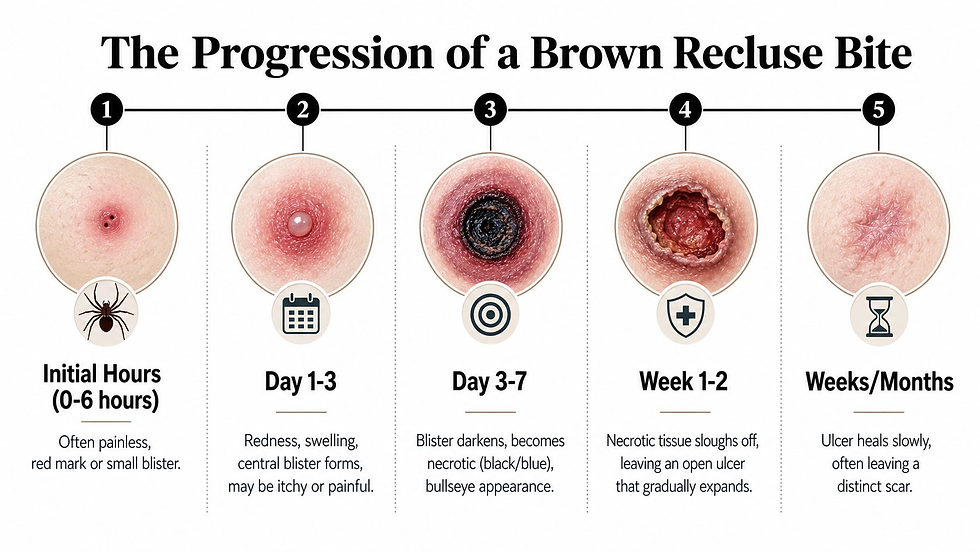
Bites happen, but they are rarer than the internet suggests.
Recluse venom is hemotoxic, and a bite can cause a slow healing, ulcerous wound. That is real and worth taking seriously.
But these spiders do not hunt people. Almost every bite happens when the spider gets pressed against skin. You roll onto one in bed. You pull on a shirt off the floor. You reach blind into a box.
If you think you were bitten, see a doctor. Do not wait and do not self treat. Plenty of wounds blamed on recluse turn out to be a staph infection or something else entirely, and getting the right diagnosis changes the treatment.
What Can You Do Right Now?

Free stuff first. It works.
Shake out clothes, shoes, and towels before putting them on
Get clothing off the floor, especially in bedrooms and laundry areas
Swap cardboard for sealed plastic bins
Pull beds away from the wall and keep bedding off the floor
Vacuum closets, corners, and behind furniture on a regular basis
Set sticky traps along baseboards and in closets. Best way to monitor what you actually have
Sweep up dead insects. Dead bugs are food. Less food, fewer spiders
Seal gaps around doors, windows, and utility penetrations
One heads up before the hardware store run. K-State research found that over the counter sprays do not reliably control brown recluse. The spider has to make direct contact with the product, and recluse spend most of their lives tucked into voids and cracks where sprays never land.
So if DIY has let you down, that is not on you. Surface spraying just does not match how this spider lives.
When Is It Worth Calling?
Reach out if:
You are finding them repeatedly, not just once
Sticky traps keep filling up
Someone in the home has been bitten
Your basement, attic, or crawl space is packed with boxes and clutter
You are buying or selling and want a straight answer
Effective spider control here means inspection, treating the voids and cracks where they actually live, trap monitoring so you can see progress, and honest guidance on clutter and sealing.
The Bottom Line
Brown recluse are part of living in Kansas. Most brown spiders in your house are not one of them.
Count the eyes. Check the legs. Then decide.
Bug Shockers is fourth generation and family owned. We cover Overland Park, Leawood, Olathe, Lenexa, Shawnee, Prairie Village, and the greater Kansas City metro. No contracts. Ever.
Still not sure what you found? Send us a photo. We will identify it for you, no strings attached.
Bug Shockers Pest Control. The Shockingly Smart Choice.


Comments